
Businesses in B2B markets often run blogs where they publish company news, product launches, and—if they have a strong content marketing team—educational content.
How their content performs is largely dependent on how it’s presented. Not all content is created equal, and the articles that earn engagement are the ones that share new information or take a bold stance.
Encore360 recently sat down with Andy Crestodina, co-founder of Orbit Media, about how companies can craft content that earns engagement while establishing authority.
According to him, companies should only focus on publishing three types of content:
- Original research
- Strong perspectives
- Sales-aligned content
If their post doesn’t fall under one of those categories, he says, they shouldn’t bother publishing it at all.
Original Research
New research and statistics about a certain topic perform well for a variety of reasons. They’re relevant to a wide range of professions, drive leads, and earn backlinks easily.
“Research makes the website a primary source for new information,” Crestodina says. “Those that publish it are primary sources, and they provide catnip for other websites.”
As a former journalist in the CEA industry, I can certainly attest to this. In most of the articles I wrote, I cited some statistic or an interesting piece of information to strengthen my argument.
One statistic I think I’ll always recite by memory: The average age of the American farmer is 58.1 years old.
Crazy, right? I’ve heard several speakers and ag writers cite this stat to emphasize how young people must consider farming as a career path. Our future could quite literally depend on it.
There are probably several shocking statistics in your industry that you haven’t heard about yet, but someone has. Find their research and cite it in your next piece.
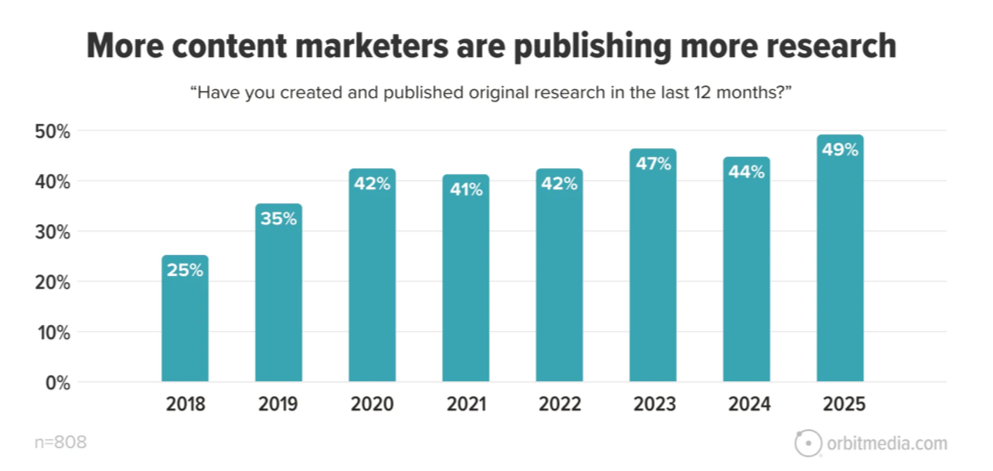
Here’s an example from Crestodina’s blog. It’s part of an annual survey that has tracked content trends over many years. You can see the rise in popularity of original research as a content format.
Strong Perspectives
“Strong counternarratives, taking stands, and planting flags is exactly what the algorithm rewards,” Crestodina says. “It’s more memorable and provocative, resonating much stronger than content that doesn’t have any point of view.”
While the algorithm may reward content that takes a clear stance, writers must be willing to take the risk. More often than not, the need for audience approval overtakes the potential to go viral.
This is a struggle for me, too. And unfortunately, my content pays for it sometimes.
“Content that doesn’t take any risk often tastes like water,” he explains. “It’s not likely that if I read it I’ll engage or comment. Many writers decide that playing it safe is greater than the potential benefit of sticking your neck out a little.”
This isn’t uncommon. People write with their boss in mind, and share content that doesn’t ruffle any feathers. But if writers were willing to be a tad “controversial,” Crestodina says, they would probably perform in the top 5% of content marketers.
The fear of being a pariah in your industry is hard to overcome. But the bar is so low that a little courage goes a long way.
Sales-Aligned Content
The questions customers ask during sales calls are directly aligned with your content goals—dedicate a post or two to answering them.
“That’s content at the bottom of the funnel,” Crestodina explains. “It will help you close deals, and reps can send it to clients right after their call.”
No one knows customer pain points and challenges better than your sales team. They’re on the front lines every day, hearing what people like about your product and what they don’t.
While it’s effective to schedule some time with your sales team to discuss the challenges they’re hearing about most often, Crestodina suggests looking over the sales call transcripts. “With a transcript, you can get the voice of the customer summarized and synthesized without relying on the salesperson’s memory,” he says.
Next time you write sales-aligned content, download 50 transcripts from recent sales calls. Then, upload them to an AI platform, asking it to identify customers’ most common questions and concerns.
Up until now, Crestodina hasn’t seen a single content marketer take this approach. It could be worth trying.
All three of these content approaches help get more eyes on your writing. But establishing authority? Surprisingly, that’s a much easier task.
Establishing Authority
Content that gets engagement and backlinks signals brand credibility and authority. But when can companies claim they’re credible and authoritative enough to speak on a topic?
According to Crestodina, whenever.
“Companies claim authority, it’s not given,” he explains. “If you have a point of view, own it. People might disagree with you, but deciding that you have a right to sit at the table and say those things is essential.”
Someone doesn’t automatically have authority because they hold an important role at a large company. In fact, most of those people fear taking a strong stance to uphold their company’s positive reputation. As a result, they end up saying meaningless words.
“I’ve heard some of the most boring speeches given by people who work at big brands and have a big logo behind their name,” Crestodina says. “I’ve also seen people who have no reputation publish things that I’ve bookmarked, screenshotted, and linked to because they break things down so well.”
The only thing standing between you and authority is claiming it.