Wastewater isn’t the first place you’d expect to find a marketing team experimenting with the latest AI tools. Over the last year and a half, SewerAI has changed that.
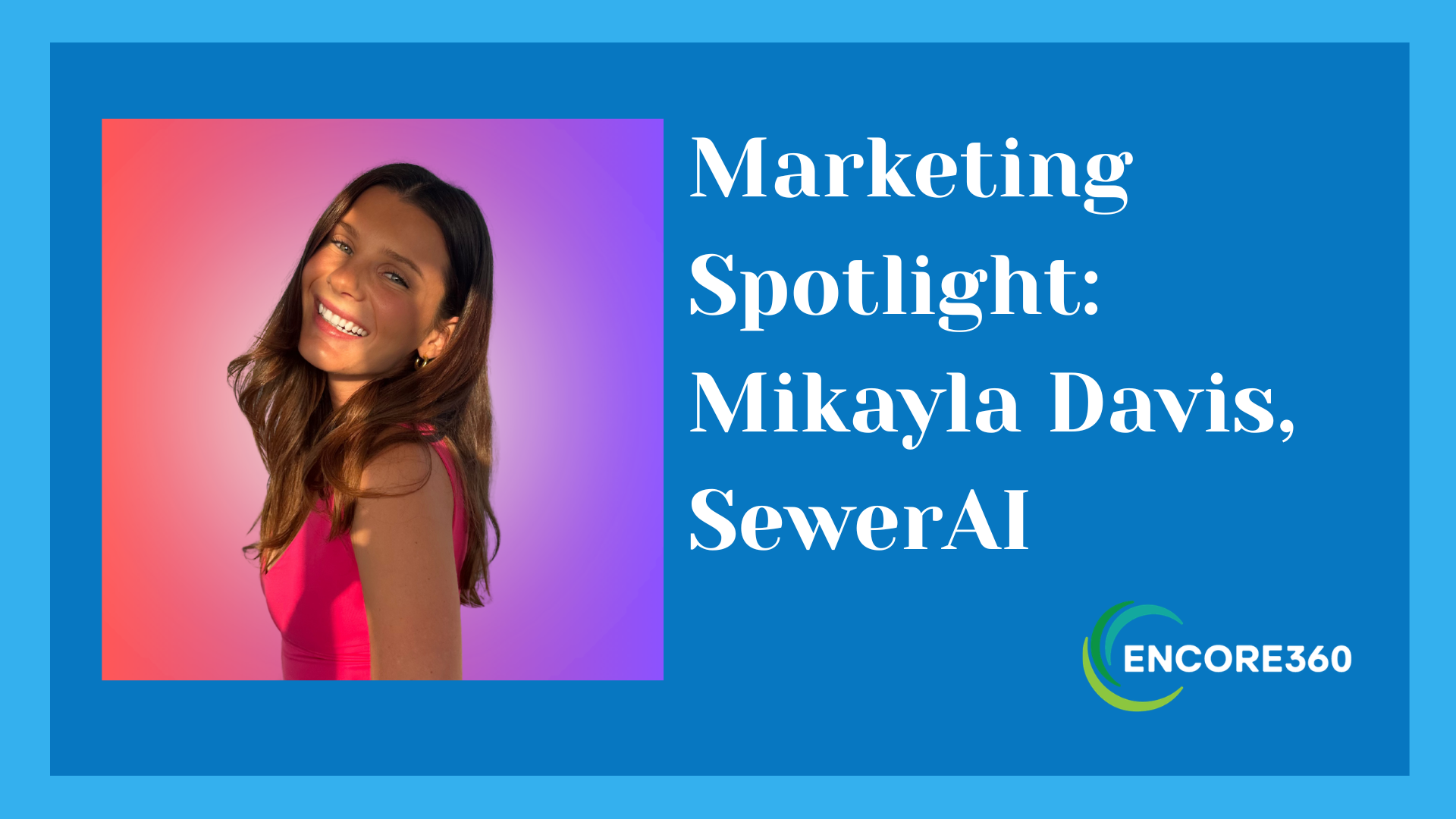
For our first marketing spotlight, we sat down with SewerAI’s Director of Brand and Demand Mikayla Davis to discuss her role, how she handles product launches, and how she integrates AI tools into her daily work—including where she sees the most potential for AI and which use cases are overhyped.
Encore360: Tell us about your role at SewerAI.
Mikayla Davis: When I joined SewerAI, I was the company’s first dedicated marketing hire, so a big part of my role early on was building the marketing foundation while helping the company scale quickly.
Because we were operating as a lean team, I was involved across nearly every aspect of marketing, from field marketing to product launches, customer engagement, content strategy to digital campaigns, and everything in between.
As the company has grown, we’ve expanded the team and leadership structure, which has allowed me to focus more deeply on brand, demand generation, positioning, and strategic campaigns.
You do a lot of preparation work leading up to product launches. What is your process like for that?
Product launches are really cross-functional for us, especially as a lean team. It usually starts with our amazing product team because they’re done the customer interviews, built and tested the workflows, and they deeply understand the needs of our customers that we’re trying to solve for.
From there, marketing’s role is translating all of that technical depth into a story the market immediately understands. A lot of product marketing today is about connecting features to real operational impact—how this saves time, improves decision-making, increases efficiency, or changes someone’s day-to-day workflow.
Once we have the positioning dialed in, we build the launch strategy around it: the messaging, campaigns, content, customer stories, webinars, sales enablement, all of it.
One thing we’ve learned is that in infrastructure, the best marketing comes from customers, not companies. Buyers want to hear from peers who are actually using the technology in the field.
When we launched Risk & Rehab in 2025, we brought customers like Delcora and the City of Sonoma into the launch conversation early. Instead of us just talking about AI, attendees got to hear directly from organizations exploring how these tools could impact their real-world operations. That authenticity is what really drives engagement in this industry.
With a name like SewerAI, AI must play a large role across your entire company. Can you walk me through one way you use AI in your marketing strategy right now?
Because we’re an AI company, we spend a lot of time thinking about where AI genuinely creates leverage versus where human perspective still matters most.
Even a couple of months ago, AI tools were not in the place where they could develop and design on-brand marketing assets. But it’s happening so quickly, and we’re seeing that it’s actually working if all your inputs are correct.
We’re doing a lot of experimentation on that front right now. The goal is to scale marketing more effectively across the organization while maintaining brand consistency. We’re still driving the strategy, messaging, and creative direction, but AI helps us move faster and support a growing organization much more efficiently.
Now, the content is still produced by us and has our expertise and field insights, but we’re able to hand it off to AI to design something that is authentic and truthful to our brand.
What is one marketing AI application you think is overhyped right now?
I think AI-generated thought leadership is one of the most overhyped use cases right now.
AI can absolutely help with research, synthesis, and operational efficiency, but true thought leadership still comes from real experience, customer understanding, and original perspective.
The more AI-generated content floods the market, the more valuable authentic expertise and human insight become.
If every company sounds the same, brand and perspective become the differentiator.
Earlier, you said the story is best told from your customers’ point of view. How do you bring them into the conversation?
The things that we’ve leaned into most are authenticity, education, and community to show real operational value for our customers. We built Sewer University as an ongoing educational program for our customers, and it has become a valuable way to drive adoption of our platform and build community among peers who are doing similar things.
Every month, we do a 60-minute webinar that’s hosted by our customer engagement team. We host the webinar, a live Q&A session, and share custom guides and other materials with attendees afterwards.
The engagement we’ve seen really reinforced to us that more hands-on education and community-driven experiences are something the industry has been missing.
What excites you most about your daily work?
What excites me most is helping shine a light on an industry and a group of professionals that deserve far more recognition than they typically receive.
The people responsible for maintaining our wastewater infrastructure are truly the guardians of public health and our communities. They’re doing incredibly difficult, highly skilled work that most people never see or think about, yet modern society literally could not function without them.
A big part of our brand philosophy at SewerAI is centered around evoking pride in that work and celebrating the people behind it. Technology is important, but at the end of the day, this industry is powered by people.
For me, the most rewarding part of this role is helping elevate those stories and helping an industry that has historically operated behind the scenes finally get the visibility and recognition it deserves.
Editor’s note: This interview was edited for clarity and length.