
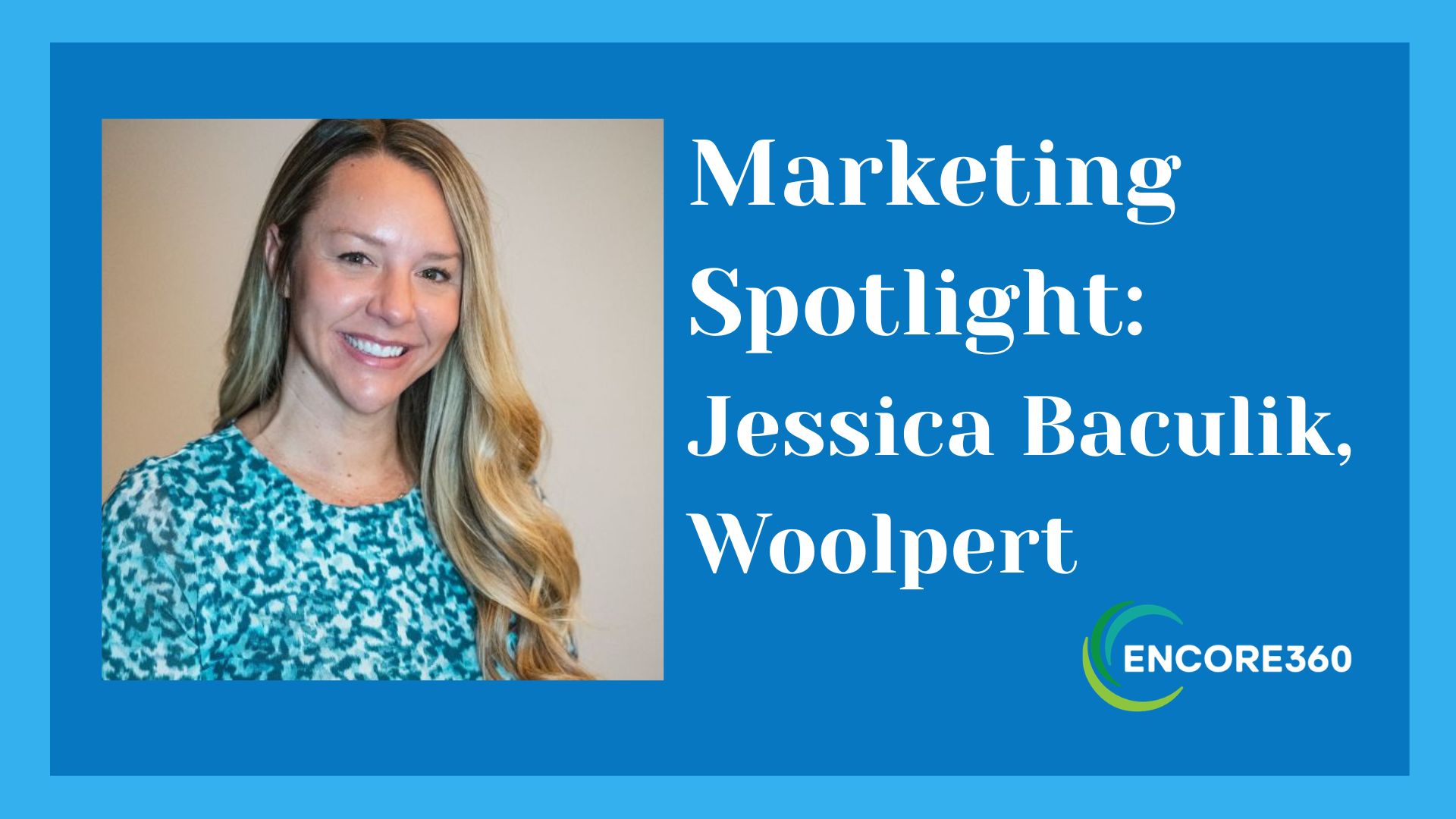
Jessica Baculik has spent nearly 20 years in technology marketing, most of it navigating the kinds of companies where the product changes faster than the content calendar.
As Director of Product Marketing at Woolpert, she translates cutting-edge technology into content that works for audiences ranging from city assessors to cloud architects. It’s complex work that requires both technical fluency and the ability to move fast when the landscape shifts.
What makes Jess’s approach useful is how pragmatic it is. She’s not chasing trends for the sake of it. She’s building systems that let her team respond when a new Google product that Woolpert resells drops or when the sales team needs enablement content they can actually use.
In this conversation, we talked about how her team captures subject matter expertise, how AI is changing both content creation and content discovery, and why rigid content calendars don’t work when you’re marketing technology that evolves by the quarter.
If you’re trying to build content in an industry that moves faster than your planning cycles, this one’s for you.
Encore360: How did you find your way into marketing and content in general?
Jess Baculik: Marketing has always been my livelihood from the start. I went to Penn State for my degree in marketing, and when I graduated, I hit the ground running with a marketing career.
From my early 20s, I’ve been in technology marketing. I started at an IT service management company and handled their marketing before the entire SaaS boom even hit. Once that happened, that’s when I really took off with recurring-revenue-style marketing, and I’ve been doing it ever since—so, almost 20 years now.
Content has always been key. It’s been an integral part of my journey, whether that’s through things like thought leadership, blogs, video content, or white papers. Really elevating the companies I work for as subject matter experts in the industry is huge, especially in technology where everything changes so fast and you have to stay cutting-edge.
Another vital area of content marketing is customer content. The customer voice is so important, and that’s another piece we really try to dive into as well.
Having that tech background is so crucial for marketers today, and not everybody has it. You’ve got to juggle technology, audience behavior, analytics, the content itself, brand strategy. We all wear a lot of hats. There’s no clean way of ranking all those things, but what are some of the most important things to prioritize from one project to the next?
I always think about how lucky I am to be marketing Google technology for businesses today.
Having the ability to work so closely with Google’s stack—especially with everything they’re releasing lately like Gemini Enterprise—is incredible. With AI being such a massive force, that’s really where everyone’s priority is shifting.
For me, being a marketer who positions Gemini Enterprise to clients while also using it internally has been a game-changer. I’ve been able to learn it firsthand, which directly improves our content strategy and creation. It solves that “wearing too many hats” problem by streamlining our workflow.
When you work on the cutting edge of tech, you’re exposed to the latest and greatest daily, which means you can adapt to new trends and deliver impactful results much faster.
It’s a great vantage point because any marketing team in the world is having conversations about Google regularly. Google pioneered search, but they also set the benchmark for EEAT and authority-building content. Maybe define that a little bit and talk about some common ingredients that go into good authority-building content.
We put EEAT into practice firsthand a couple of years ago when we rebuilt our Woolpert web presence. Because we transitioned to stand more uniquely on our own, we essentially had to rebuild our authority from the ground up.
It takes a massive amount of coordinated effort. You don’t just flip a switch and suddenly rank; you have to optimize every technical detail and piece of content so that it genuinely demonstrates subject matter expertise and sparks the search engines. To build that authority, we couldn’t rely on just one channel; we paired organic SEO optimizations with targeted campaigns and high-value content to drive momentum and establish our digital footprint.
But the landscape is shifting rapidly. Especially now with AI-driven engines taking over so much of online discovery, you have to stay on top of things constantly just to stay in the conversation. Making sure your brand is cited and appears inside those AI-generated summaries feels almost more vital today than traditional keyword rankings.
I’m fascinated to see where we are even six months from now, because I know I’m personally reading those AI-synthesized responses for almost everything I search. Why wouldn’t our B2B buyers be doing the exact same thing?
How have your own and your team’s search habits changed as consumers?
That’s a great question, and honestly, a really good brainstorming exercise for our team to dive into.
B2C marketing is obviously different from B2B, but the underlying human behaviors are similar. From a B2B perspective, there’s much more authority and trust required when purchasing complex products or services. But at the end of the day, B2B buyers are still consumers in their personal lives.
As a consumer, I’m absolutely looking at AI summaries first now. Whether I need restaurant hours, quickly scanning reviews, or just trying to find out if a place is dog-friendly, the goal is always to get answers faster.
The summaries speed that entire process up. You get a quick, well-rounded answer, and you can take immediate action. It’s fascinating to consider how this new baseline expectation for instant, synthesized answers is fundamentally changing buying behavior across both B2B and B2C.
The content you work with at Woolpert is inherently complex: geospatial technology, AI, cloud systems. Your audience is sophisticated too. How do you think about simplifying content while still respecting the audience’s expertise?
I’d actually argue that even with a sophisticated audience, many people are still at the 101 level because the technology is moving so fast that we’re all essentially learning at the same time.
One of our biggest challenges as marketers is breaking through the noise. Sometimes, that means stripping away the hype and getting back to basics when introducing a new capability.
A major focus for us in 2026 is driving pilots .
So many companies are talking about integrating things like AI and advanced security, but they are hesitant because of the sheer speed of change and the need for robust guardrails
Pilots solve that friction. We tell our clients, “Let’s isolate just one specific workflow and prove what’s possible on a smaller scale first.”
Take AI as an example. Instead of a massive, overwhelming rollout, we can look at a cohort of say five employees. We study their day-to-day processes to see if a tool can save time, improve efficiency, and eliminate bottlenecks they’ve struggled with for years. Once we prove that micro-value, the pilot naturally becomes a tool to educate the rest of the organization and scale horizontally.
I apply that same “baby steps” philosophy to my own daily work. I continuously look for ways to use AI incrementally—whether that’s leveraging Salesforce integration to pull the latest client use cases, or testing automated workflows with an agent.
You don’t have to master everything on day one. It’s okay to start small, build confidence, and learn as you go.
Perfect setup for a more pointed AI question. We’re all learning this together as marketers and content people. How have you incorporated AI into workflows? What’s worked? What’s been exciting?
It’s used everywhere across the business.
The teams use it to get a more holistic view of prospects and client use cases. Marketing uses it to amplify content creation. We use it to summarize information because there are so many documents and so much data living in silos.
What’s exciting is seeing AI analysis pull all that information together. Even local governments are taking huge amounts of paper documentation and building digital footprints so they can analyze historical insights.
That’s actually part of the thought leadership we’re working on next: bringing all the data together into one system and uncovering meaningful insights from it.
At this point, AI is becoming more of a daily function rather than something you occasionally test out.
I think that’s a great way to approach it.
We’re finally figuring out how to actually do more with less. Everybody’s always said that phrase, but now we can actually show how.
Alongside all this technology are the humans themselves: the subject matter experts. Why is it so important to get those humans involved instead of just relying on documents and research?
Because the people matter.
At the end of the day, there’s still a human behind the work. Technology can improve efficiency and speed up processes, but the work is still being done by incredibly smart people.
We have amazing individuals on this team, and I want prospective clients and existing clients to hear those voices because those are the people helping solve their pain points and improve their businesses.
That human perspective should never go away.
Looking ahead to Q3 and Q4 and beyond, what have you learned about content planning and calendars?
I’ve lived in both meticulously planned and highly agile marketing environments.
I’m fully capable of mapping out an entire year’s worth of content, but when you’re working in the Google ecosystem, everything can shift the moment a new innovation drops. You have to be ready to pivot.
That’s been the name of the game for me over the last eight years. There is always amazing technology coming out that forces you to re-evaluate and re-prioritize on the fly to stay relevant.
You still need that foundational content—those “evergreen” trends and seasonal topics that keep the engine running—but in technology, you can’t stick rigidly to a 12-month plan. If you do, you’ll miss the most interesting opportunities to lead the conversation as it’s actually happening.
Looking ahead across marketing, content, and tech, what are you most excited about over the rest of 2026?
It’s hard not to focus on AI when it’s so transformative, but what excites me most right now ties directly into my new role as Director of Product Marketing across all of Woolpert. My primary focus for the rest of 2026 is translation and tailoring.
We do incredible, highly technical work on the Woolpert Digital Innovations side, but the real opportunity is taking those cutting-edge solutions—as well as the other products I currently market or will in the future—and translating them into practical, everyday business value. We want to make these technologies highly relevant for our more traditional architecture, engineering, and infrastructure clients. It’s about tailoring the narrative so that a city planner or a civil engineer immediately sees the ROI of a complex solution in their own language.
To do that effectively across so many distinct audiences, we have to empower our internal teams, which is why we’re building custom marketing and sales enablement agents.
For example, for the Digital Innovations team, we’re piloting Capability Portfolio Agents that can instantly surface our offerings cross-referenced by industry, job title, or location. We’re also building Event Agents so a team member at Google Cloud NEXT can just ask, “What does my Wednesday schedule look like?” and get a personalized itinerary.
My goal over the next six months is to dive in with my Marketing peers and give our sales teams across every sector the ability to find exactly what they need to showcase the full breadth of solutions we can provide our clients. Ultimately, it’s about creating a centralized, intelligent nucleus for our data—turning our collective expertise into an on-demand resource so we can customize our messaging faster and drive the whole business forward.