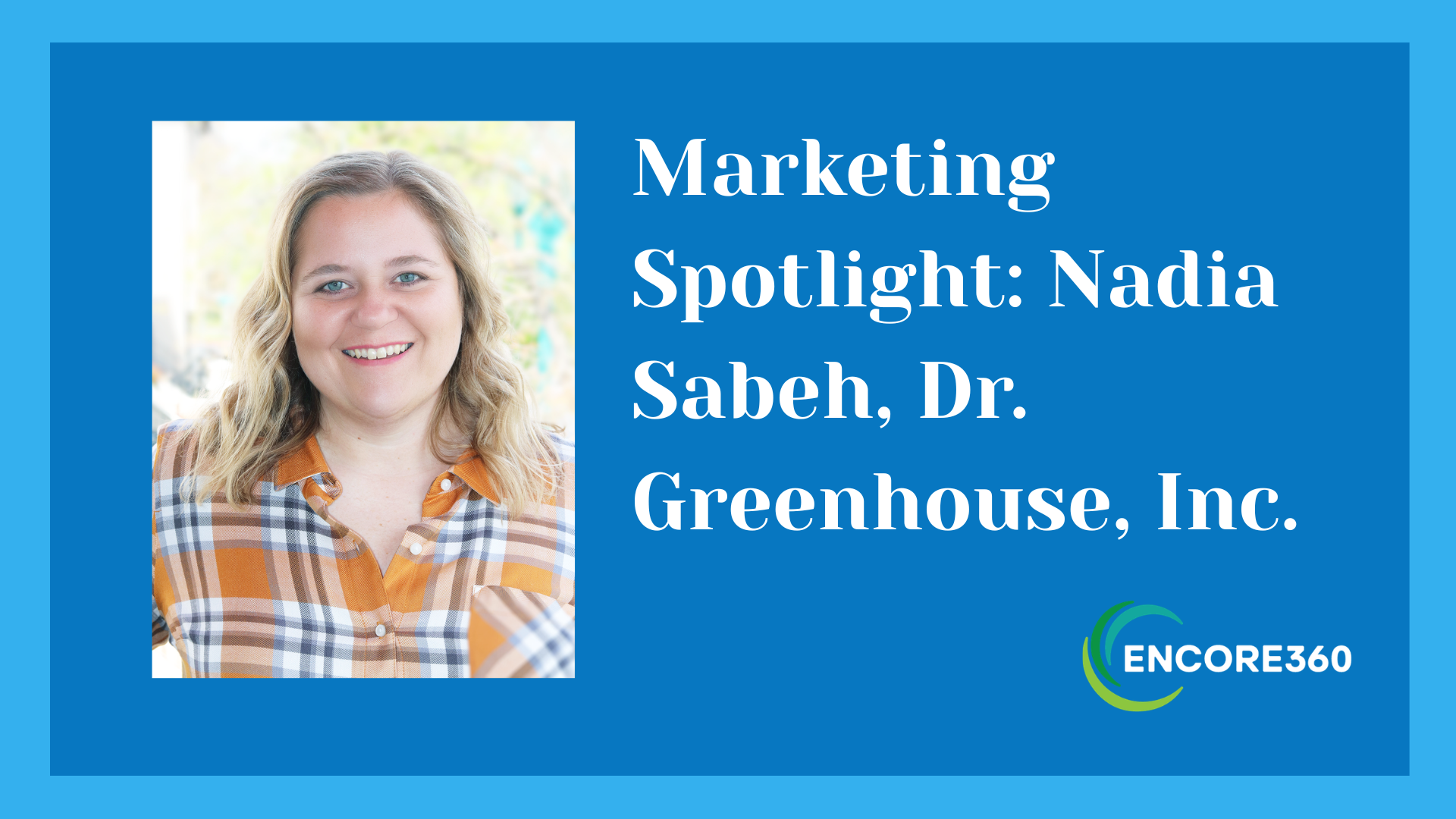
Over the last 28 years, Nadia Sabeh, Ph.D., founder and president of Dr. Greenhouse, Inc., has created a field of her own: mechanical agricultural engineering.
She said it herself—no one in CEA is doing the work she’s doing. Nadia combines agricultural engineering’s focus on nutrients and lighting with mechanical engineering’s focus on temperature and humidity to create her own unique niche. This niche has since become the Dr. Greenhouse brand.
Not only has she built brand recognition and authority throughout her career, but she has learned to navigate the polarizing landscape of CEA in a direct way.
In this conversation, we talked about Nadia’s path into CEA and entrepreneurship, brand leadership, the future of AI in marketing, and so much more.
If your company is small but you have a big voice, you’re not constrained to the size of your team. Nadia is a prime example of that.
Encore360: Tell us about your journey into CEA and becoming an entrepreneur.
Nadia Sabeh: I’ve been in CEA for almost 30 years now. When I was an undergrad at UC Davis, I took an internship on a commercial mushroom farm. We were essentially trying to grow shiitake and oyster mushrooms in the desert. I feel very lucky that I started in mushrooms, because, unlike plants, they get all the water and nutrients they need at the beginning of the growing process. Mushrooms also don’t need light.
So what’s left in the third leg of that stool? It’s the climate. Once we started producing the fruiting bodies of the mushrooms, we focused on the climate: keeping the greenhouses cool and humid in the desert. It was a challenge! That’s how I got interested in controlling the greenhouse environment.
I realized if you could grow mushrooms in a greenhouse in a desert, we could grow food anywhere using controlled environment agriculture (CEA). It didn’t have that name yet—it was just the greenhouse industry. I could see myself wanting to feed the world using greenhouses as an undergrad.
After getting my Ph.D. at the University of Arizona, I kept thinking there was this other industry, architecture and mechanical engineering, that goes into building the environments we live and work in. I wanted to learn how they designed HVAC systems for those types of buildings so I could bring those ideas and concepts back to agriculture. So, I worked as a mechanical engineer for 10 years with the goal of tying that back to CEA.
When Dickson Despommier published his book on skyscraper farms, people were inspired to build vertical farms and cannabis growers needed a secure location to grow indoors, not out in the field. The company I worked for started getting phone calls about growing cannabis and veggies indoors.
I don’t think at that point the company really knew what my background was. So of course I volunteered to work on those projects. I tried to create a division of the company that focused on CEA, but I soon realized that if I was going to combine my two passions successfully, I had to go out and do it on my own.
It was December 2016, so 10 years ago, that I officially left my secure paying job and started Dr. Greenhouse, first as a sole prop, and then later as an S- corp, growing it to eight employees. Since starting the company, we have worked on over 200 projects in over 40 states, plus five Canadian provinces and territories, and 15 other countries around the world.
How did you come up with the name Dr. Greenhouse?
I just laugh because when it comes to the name Dr. Greenhouse, people always ask me where it comes from. Well, it came from a weather station when I was doing my PhD. I put on a workshop because of course I love to teach and one of the local weathermen interviewed me to help promote the workshop.
When we introduced ourselves, he said, ‘I hope you don’t mind, but around the studio we’ve nicknamed you Dr. Greenhouse.’ And we just decided that was marketing gold. I immediately set up a website with that name, because that’s who I am.
How did you build a recognizable brand in such a niche industry?
I think that I was able to create this niche at first because there was very little interest or expertise in the environmental control of indoor farms. Even to this day, when I look at the research that grad students are doing and the publications that are out there, it’s still very heavily focused on nutrients and lighting. You don’t see a lot of studies that are looking specifically at temperature and humidity. Temperature and humidity are the conditions you give students to study the lighting—it’s not the variable that is being changed necessarily.
The same can be said on the engineering side of things. I can’t think of a single other mechanical engineer that had the experience or know-how 10 or 15 years ago to design an HVAC system geared specifically for indoor farms and greenhouses. Still today, I could maybe count on two hands the number of mechanical engineers that understand that we’re not just controlling temperature and the heat from the lights, but we’re also controlling the humidity generated by plants. Compare that number to how many lighting and irrigation experts are serving the industry.
Even at that, I would say the engineers who are good at designing those systems are not really necessarily thinking about the biology and physiology of the plant. They’re thinking more about controlling the end result as opposed to the biological process behind the result.
I think that sets me apart in a lot of ways. I started in agricultural engineering then went into mechanical engineering. I consider myself a mechanical agricultural engineer. There just are not many, if any, people that have both areas of expertise and experience. So that definitely sets me apart from the beginning.
I think another reason why my brand is so well recognized is because of the education I put out there. My goal has always been to get good information out to the industry to help it be as successful as possible. Over the past 10 years, I’ve spoken at countless industry events, written more than 50 blogs, recorded over 100 podcast episodes, and given in-person workshops for anyone interested in learning more about environmental control of greenhouses and indoor farms.
I’m also crop agnostic. I’ll help growers who are growing anything. The reason I got my Ph.D. in the first place is because I really wanted to teach at the university level—that is my end goal and retirement plan. People say I’m crazy because it’s hard to be a university professor, but whatever. Running a business is hard, too.
CEA, especially vertical farming, can be a polarizing topic on social media and in blog posts. How do you touch on these industry challenges professionally on LinkedIn and in your own content?
Vertical farming has had a tough go. It was very exciting 10-15 years ago. I think a lot of the broken promises as well as the high costs of production have really damaged the reputation or credibility of vertical farming. That doesn’t mean that there isn’t a place for it or that it can’t be successful.
Whenever I see a post about vertical farms, it typically falls into one of two buckets right now. One is people still saying, this is going to be the best and biggest vertical farm. My response usually to that has been shortened to ‘I’ll believe it when I see it’ or I just won’t comment at all.
Camp number two is vertical farming is never going to work. Here are the mistakes, here’s why this is a stupid idea, blah, blah, blah. How I have come to respond is thinking about the bigger picture and achievable “hows” as opposed to pointing out what the mistakes were.
Yes, mistakes were made, including putting too much weight on the vision and not enough on the “how” to achieve that vision. Focusing on how to grow healthy plants in a vertical farm will make it a lot more successful than throwing billions of dollars at technology that automates the death of a thousand plants. But “how” takes work, not just all the dollars.
What are your thoughts on the future of marketing in general?
I know some people are saying this already, but I just want to reiterate this because I do think that it’s true. People are going to get AI fatigue and are going to recognize when something is computer generated as opposed to human generated.
I do think that people are going to look more, or at least recognize when something that is written or graphically designed by a human as opposed to being generated by a computer. They are going to start seeking out authentic voices. Using your own voice will differentiate you from the competition, who will be pressured to use AI that turns content around quickly but sounds generically like everyone and no one at once.
I think most people who read the things that we put out at Dr. Greenhouse would notice pretty quickly if I didn’t write it—they might not even know that I have been writing our content since the beginning. Maybe I should do a beta test and put something out there that was produced by Claude or ChatGPT to see if anybody notices a difference.
I think I have a pretty clear voice. Anyone who’s listened to my podcast, watched my YouTube videos, seen me speak, if they read the blog, they can probably recognize that it’s me who wrote it. There’s almost always going to be something snarky in there.
Is there anything else you’d like to share about your marketing strategy or the Dr. Greenhouse brand?
Try to use your own voice because you have feelings, beliefs, and opinions about things. I think it’s okay to share that because that’s what connects you to people.
That’s why a lot of people connect to me and Dr. Greenhouse. I’m not afraid to say what other people are thinking. I’m not afraid to call people out on their B.S. I’m not afraid to ask hard questions. I’m also not afraid to be proven wrong.
Editor’s note: This interview was edited for length and clarity.