I keep a Moleskine on my desk, but I don’t use it for “work stuff” or client content. I jot down moments from my life and little creative mantras to remind myself of what I want to do with my work.
When I land on a line that captures something true about writing or content, I write it down by hand. Now, my handwriting is not particularly good, but it is mine. The product, then, is just ink and whatever thought needed to get out of my head before it disappeared.
Then, sometimes, I photograph it and post it on LinkedIn. There’s something people respond to in it that the polished stuff never quite gets right.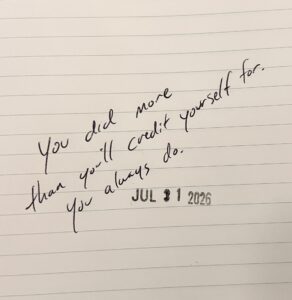
Why the Mess Works
Austin Kleon has a phrase for this: “Use your bad handwriting.” The imperfect, human artifact proves the thinking actually happened.
A polished slide deck could’ve been made by anyone. A messy note in your own hand could only have been made by you.
That’s the entire argument for showing your work instead of just showing your conclusions.
What Most B2B Teams Do Instead
Most content gets smoothed into something presentable before anyone sees it. Every rough edge sanded down, every crossed-out word cleaned up, every hesitation edited out.
The whiteboard session where your team actually solved the problem, now that’s a fascinating visual, but nobody photographs that. They wait until it’s a polished case study with a stock photo of people pointing at a screen.
The strategy doc with three different directions crossed out before you found the right one? It’s usually deleted, replaced with a clean final version that implies you knew the answer from the start.
But the mess is the proof. The crossed-out version shows you actually worked through something. The clean version just shows you know how to use PowerPoint.
What This Looks Like in Practice
You don’t need a Moleskine habit specifically. You need a willingness to publish the unpolished artifact instead of waiting for the clean one.
Whiteboard photos instead of finished diagrams. After your team maps out a process or solves a problem on the whiteboard, photograph it before you erase it. That photo—arrows crossing out arrows, half-finished thoughts, someone’s terrible handwriting—shows real problem-solving in a way a redrawn version never will.
Strategy docs with the crossed-out options still visible. Show the three approaches you rejected, not just the one you chose. The rejected paths are often more instructive than the final decision.
Handwritten notes from customer calls. Not the cleaned-up summary you send to the team. The actual notes, underlines and all, from the moment you were trying to understand what the customer meant.
Sketches before they become graphics. The rough sketch of a concept, made in thirty seconds with a pen, often communicates the idea faster than the polished version your design team spends two days building.
Obviously, you don’t want to overplay your hand. My Moleskine doodles are one thing; your customer calls are another. Be circumspect for the sake of your business, but be generous, too.
The Deeper Point
This is about resisting the instinct to hide your process. Whether your handwriting is good or not doesn’t matter. That’s just the hook to my blog post here.
Every polished piece of content implies a level of certainty that rarely existed while you were making it. Prospects know this. They’ve made things too. They know the finished product almost never looked finished at the start.
When you show the mess—the crossed-out line, the whiteboard with three false starts, the handwritten note you haven’t cleaned up yet—you’re not looking unprofessional. You’re looking like someone who actually does the work, rather than someone performing the appearance of having already figured everything out.
Try It This Week
Next time you land on an idea worth keeping, don’t type it into a doc and format it. Write it down. However you write. Then share exactly that, unedited.
You’ll probably feel like it’s not ready. That’s usually the sign it’s worth posting.
The bad handwriting is the point (kinda).