For most people, underground infrastructure is easy to ignore. If the water flows and the toilets flush, the job is getting done.
That presents a unique challenge for marketers in the trenchless industry. How do you tell the story of work that most people never see? How do you make complex infrastructure projects understandable, engaging, and relevant to customers, municipalities, and the broader public?
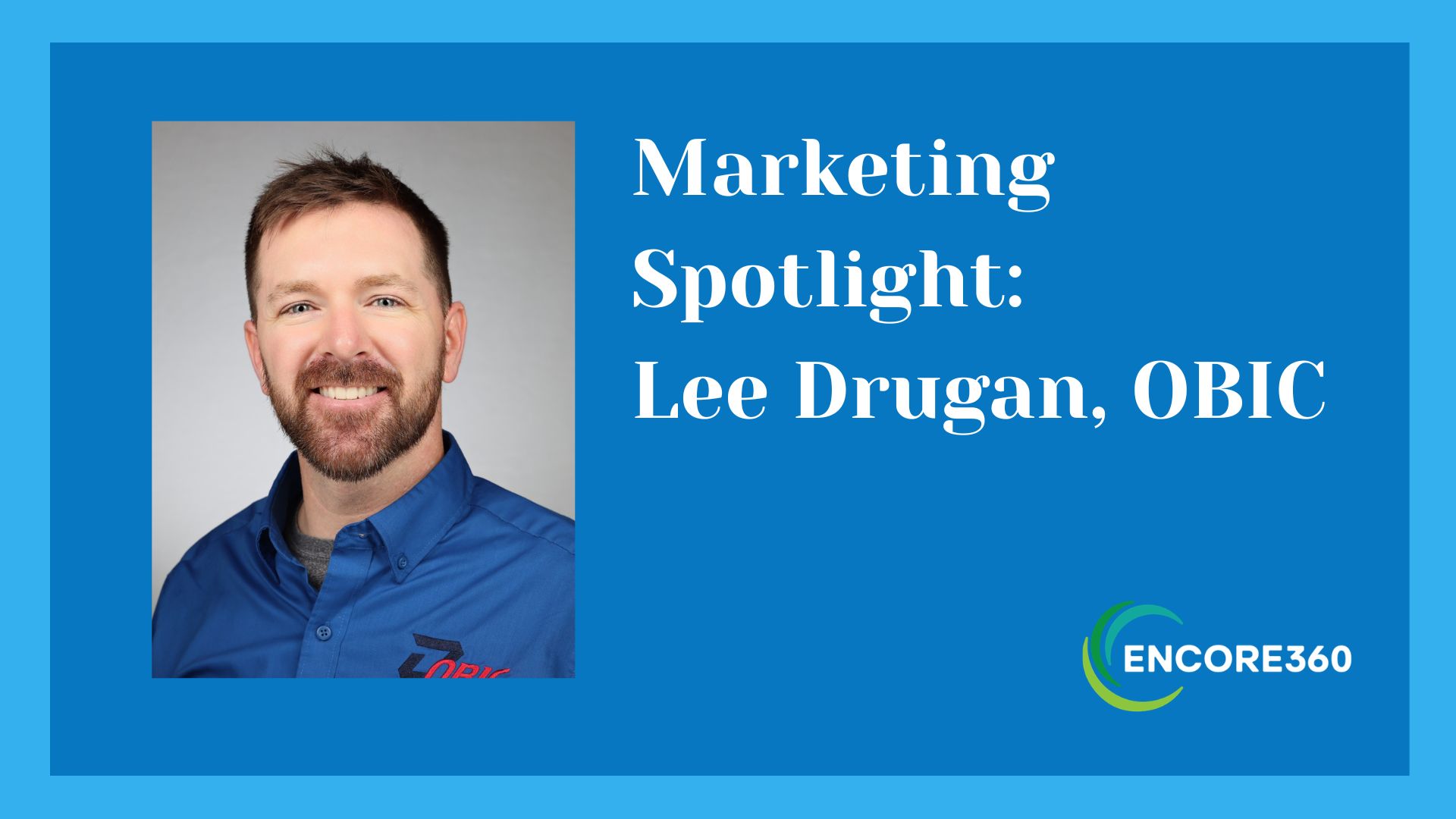
Few people have spent more time wrestling with those questions than Lee Drugan, marketing manager at OBIC. Over the past decade, Lee has built a reputation for documenting the trenchless industry from the ground up. He has spent countless hours on jobsites, helped launch the company’s video-first content strategy, and co-created The Trenchless Table podcast, a show that explores leadership, workforce development, and the evolving trenchless industry.
In this conversation with Encore360, Drugan discusses learning an industry through the field, why showing up on jobsites matters, what he’s learned from building a podcast audience, and why consistent storytelling has become one of the most valuable tools in industrial marketing.
Encore360: What led you to marketing and the trenchless space specifically?
Lee Drugan: I started early on as a marketing assistant for a self-book publishing and printing company called Bookmasters. That gave me a lot of experience across the board. I was thrown into the trenches in that position, handling social media, doing design work, and whatever else the department needed. At that time, social media was new in the marketing world, so I was helping a lot of self-pub authors set up their social media accounts and figure out ways to utilize it to promote their content. I was also designing ads and doing different things.
From there, I moved out of the marketing world for a minute and into a document coordinator position for a steel manufacturer. As a steel manufacturer, you are audited all of the time, so I learned a lot about file management which I still utlize today. But in that position I was lacking the creativity I liked in the marketing world. I found a marketing manager position at American Augers, which was closer to home and at the time we were welcoming our first baby, so it was a great personal move. I took that position not knowing anything about underground construction.
In that role, I was handling the marketing for American Augers’ directional drills, auger boring machines, mud systems, and also Trencor trenchers. So I got a deep dive into the trenchless world. At that time, content marketing really wasn’t like it is today. It was a lot of print advertising, paying $5,000 for a full-page ad. I didn’t understand why companies would want to do that, but I was still pretty new, so I never really questioned it. Over the years, I started transitioning our marketing efforts there into more of the digital world. I really grew a passion for telling the story of construction in that position.
I’m really happy now to be back in the construction space, helping tell that story and helping people understand the benefits of companies like ours, and what the guys actually do out in the field for the rest of the community.
Could you talk a bit about that deep dive? You’ve been working with this industry cumulatively for a number of years. How have you navigated that learning curve?
For me, hands-on is the best way to learn. Not hands-on as in driving equipment, but I spent a lot of time on job sites, and I think that was really important. In my roles over the years, I’ve been a one-man band for a lot of companies in the marketing world. I’m the photographer, the videographer, the editor, the poster. So for me it was: how do I tell that story with continuity? On the other side, it was a lot easier for me because I was the one in the field. I was able to talk to the guys and get firsthand experience on the job sites. That helped me learn a lot and also gain respect from the guys out in the field, because in the construction world, you have to earn respect before they’re really willing to help you with what you need.
When I’m out getting content, my approach was: show up on site with the proper PPE, and ask the foreman, “Where can I be that I’m not in your way? I need to get my content, I can get in and out as fast as possible, but you need to tell me where I can be, and you guys need to have your proper PPE on too, so my whole trip here isn’t wasted.” Over the years I got more confident in the way I did things in the field, but to me that was the best way to deep dive into what we do with a real understanding.
I also positioned myself with people who’d been around for a while. I take a lot of pride in finding those people who have been in the industry and learning from them, because they are the experts. I am by no means an expert in the construction world, but I know people who are, and I tap into those resources all the time for the stuff that I want to do.
This reminds me: A few months ago on LinkedIn, you posted that you were out and about with your family, and you saw a team from the company doing a job. I believe you went home, got your camera, and went back to gather some content from that. You could have just as easily not done that. Could you talk a bit about the decision to take that opportunity?
The thing about what we do is that the importance is really hard to understand. The underground construction side of things — the trenchless industry, as a whole, is trenchless because it’s less trench, it’s less digging. The idea is that people don’t see what we do or what we install, but my job is to show them how important it is. Seeing is believing in our industry. The more we can put out content that shows crews and what they’re doing — that they’re real people too — it tells our story, it tells our importance, and it also hopefully helps keep our guys safe on the job sites. A lot of times our guys are working along the roadside, and if people know what they’re doing, or have a general understanding of the job site, then hopefully people will slow down or be more cautious, or not be so annoyed when their traffic is delayed a little bit because of the guys working along the side of the road.
In our industry, we have this saying: people don’t really care what we do until they flush their toilet and the water doesn’t go somewhere, or they turn their faucet on and there’s no water there. Those are the two times people care about what we do. But really, people should care about what we do all the time, because what we’re doing is preventing those issues from happening, by rehabbing their old structures or putting in brand new systems for them.
So me going to the job site is crucial in what we’re trying to do — that story we’re trying to tell. With it being that close to home, I couldn’t turn down that opportunity. They’re literally working right outside the office right now — they’re pouring concrete for a new sidewalk, and I’ve been out there bothering them, just because they’re right here, I’m going to get pictures of them, sorry, but they’re way too close for me not to. I think an important part of any marketing strategy has to be showing what the product does, or showing what the people do.
Let’s talk about your podcast, The Trenchless Table. Could you tee up the origin story of the podcast and how you got that going?
I’m lucky in my position that the owner of the companies I work for, Dustin Schlachter, is pretty willing to try new things. We had our big OBICcon event coming up, and we were doing some work down here in the OBIC building, and up on top of the offices there was this big open area.
I just asked him, ” Why don’t you put anything up there?”
He said, “What are you thinking?”
I said, kind of joking, “I don’t know — we talked about launching a podcast, what about a podcast room?”
He chuckled a little, and the next thing I know, he’s grabbing a ladder and we’re up on top walking it out, talking about how it’d be laid out, what we’d need to do for it. The next day, there was a contractor in measuring, getting ready to go. Mind you, we’re three weeks away from OBICON, where at that time we had 75 customers coming in for this event, and I said, “You are not going to try to build a podcast room up there before all these people come in — we’re all stressed.” And he replied, “Ah, it’ll be fine. This is how we do things.”
Next thing I knew, they’re building a podcast room, and I had to figure out how to do it. From the ground up, I learned how to do video, audio, edit a podcast, where to put it — there’s a couple of channels I still haven’t figured out yet, maybe by season three. We’re in the middle of season two now.
Why a podcast at all?
We saw a gap. We have a lot of schools that come in and do tours of our facility, and we’re pretty big on trades, obviously — there’s maybe 10 people in our entire business who have college degrees, from the field to management, anywhere in between. We just aren’t that big on college degrees here. We’re more big on work ethic and experience. We’ve always been the people who tell kids — if you don’t really know what you want to do, this is a good place to land after high school, because you can try it and work your way up if you want to, and end up in a sales role or office or whatever that looks like.
We had, over and over, been talking to these students about how being a leader doesn’t mean you have to go to college to become a leader — it means you have it within you, you just have to figure out how to utilize those skills, how to bring those out. So the whole first season of our podcast was bringing on leaders from around Bryan, Ohio — Bill Martin from Spangler, Jason Beals — just all these really good industry leaders in this area. We basically talked about leadership and the next generation, and it had nothing to do with the trenchless industry. The first season — I don’t know if that was good, bad, or whatever, that’s just kind of how it ended up falling — but we ended up getting this small cult following in the construction space, and I guess it was resonating with some people.
Season two is all about the trenchless industry — we’ve talked about nothing but the trenchless industry. I have no idea where season three goes or what we’ll do with it. But right now it’s just been a good space for us to talk about things that don’t really get talked about a lot in the podcast world — construction and the trenchless industry specifically, and ultimately leadership, because that’s what we’re big on. We’re big on building leaders, or having them emerge from different areas of our business.
I’m curious what it was like getting folks into the studio. These are local contacts, it sounds like, in an OBIC network, so you’re not necessarily trying to get their buy-in for the podcast, but you are asking for their time and their personality to be recorded. Was that challenging, or how did you convey the value of this in its early days?
I wouldn’t say it was necessarily challenging, but we definitely had to sell it — show the value of why they’d want to come in. I think the value was the fact that we weren’t going to sway their narrative. We really don’t care about what people think about how we perceive things, and we’re very much “if you don’t like what we have to say, scroll 10 seconds further and we’ll probably be past that point,” because all three of us — Cole, Dustin, and myself — we’re very much squirrels in this world. We can get off track really quick. If you don’t like what we’re saying right now, go 10 seconds further, we’ll probably be talking about a different subject completely. We’re also open to differing ideas, and we’re not against having a passionate, constructive conversation.
We sold the value: come in and talk about leadership and the next generation with us, we’re just starting this, we have no idea what it’s going to do. Luckily it did well, and we’re gaining traction now a little bit. It was never about marketing for me — it was more about the content, more about doing something different. Selfishly, I wanted to challenge myself a little bit. I’ve always been the person behind the camera, so I wanted to try being the person on camera. It just kind of worked out. A couple people didn’t want to be the first few episodes — they wanted to see how it went and come in later in the season. But once they saw the first few episodes, that it was professionally done and all of that, they were happy to come on with us.
That’s an astute decision early on, to have the video component and the room built out to accommodate that. Why was that an important decision for you guys?
Because I’m visual. I black out when it comes to audio podcasts — it’s like reading a book for me, I’ve never been good at reading a book, because I’ll get to the bottom of a page and think, “Did I even read it, or did my eyes just skim this?” I have no idea — then I have to go back. It’s the same for an audio podcast. I’d much rather have a podcast on the side, listening to it, but also have the video there, because I like to see facial expressions, I like to see interactions, and I think that’s an important part of engagement with a podcast — really becoming like you know them, like you’re a part of it.
A lot of the podcasts I listen to, I watch. So that was one reason.
How have you approached ROI, so to speak?
I look at it as an exposure tool for us. I think the podcast is not going to sell product, necessarily — it might sell the idea of polyurea, but we’ve hardly even talked about it, we’ve hardly even brought up the background. I wanted Trenchless Table completely separate from OBIC or anything else. Now, OBIC does sponsor the podcast — we put them in every episode, in the description or whatever — and a lot of it’s around our installers too, which is free marketing for them to get their name out there. But from an ROI perspective, it’s never been about selling product off the podcast. It’s been about exposure. I think the more people who know about these services and what people can do, the better it is for us in the long run.
The best piece of information I got across the board happened this year. I was at a trade show — I go to the trade shows and act as a fill-in salesperson, because I can’t sell you anything, and I’m kind of the least threatening person people talk to in the booth, which is maybe why people are so comfortable with me. They came up and were talking, and they said, “Oh my gosh, we see you guys everywhere. I don’t know what you’re doing, but we see you everywhere. We see orange stuff everywhere, we see you guys have this podcast — we see you all over the place.” I just smiled and said, “I know, we really try to be kind of in your face — we’re like this wrecking ball in the industry, coming in with this big orange wrecking ball.” They chuckled a little and said, “Well, you guys are doing great stuff.” I said, “Thank you so much.” For me, that was ROI. That was somebody saying the stuff we’re doing in marketing is working.
We can look at analytics all day long, but real-world feedback of somebody saying, “We see you all over the place on LinkedIn, we see your podcast on YouTube, we can’t open our LinkedIn without seeing an orange manhole” — that to me is ROI.
Yeah, that’s hard to put into a spreadsheet, but that’s a great example of how this works.
Yeah, and I hope, down the road, we can say, in the past two years we’ve seen — I mean, we’ve done it already — we’ve seen this much growth in our business, and whether we can attribute it to digital ads, print ads, our sales guys kicking ass, who knows. But for us, it’s all working.
I call it an avalanche in our industry. We are a snowball — OBIC has its snowball of marketing activities, and our snowball, mixed with our installers’ snowballs, creates this avalanche of OBIC in the industry. As long as we keep that avalanche moving, people are going to see us. It’s the podcast, it’s the digital ads, it’s Google, it’s AI — it’s all different things, but all of those pieces end up in this avalanche of content that’s out there for OBIC.
Could you touch on those installers? Buy-in from Dustin is one thing, but buy-in horizontally is another.
Every year at OBICcon, I do a presentation on marketing, because these installers don’t have marketing people, most of them. I don’t know if any of them have a dedicated marketing person like we do — which is also me. Showing them the value of what we can do with content has helped tremendously. I’ve taught them how to self-brand — branding for a sales rep or whoever — because I think that’s where everything is going. I think AI has been extremely helpful, but I also think it’s shifted everything back to personalization. Over the next five years or so, I think fewer and fewer brands are going to use AI just to push content out — I think it’s all going to come down to everybody having their personal brand intertwined with the company brand.
Your salespeople are your front lines — those are the people, or your project managers, or even from our standpoint, the guys on the construction site — if I can get their buy-in from a marketing perspective and get them sharing content, one, that’s less I have to chase down, but two, it amplifies this avalanche across the whole network. So what I’ve done is shown these other installers how effective branding can impact their company, and what it does for making your company look professional — so when they’re trying to get in with a municipality, that municipality, when they look at their stuff, can see, “Oh, this is everything that I do, or that they do, that we could benefit from.” These installers started to trust what we were doing, they saw the benefits, and now they’re all posting on LinkedIn. I showed them analytics — I’ve been pretty much an open book to them on what our analytics look like from an Advanced Rehabilitation Technology perspective, because that’s the installation arm for OBIC for us. I showed them analytics and what we’ve been doing, and the case studies, and ultimately the network knows that if each installer grows, then Polyurea Rehab as a whole grows, and it makes it much easier for them to get in on bids and jobs. So they’re on board with helping each other out, which is really nice.
You mentioned the orange earlier, both at trade shows, and obviously there’s a lot of context to that color with the company. Could you talk about why orange is important to OBIC, and then also why a consistent brand is important broadly?
Orange — we have random things coated in orange around here, like this little donut. For us, orange has a practical reasoning behind it: when you’re rehabbing a manhole structure, you want it to be easy for crews down the road to see defects or leaks. That orange reflects light really well down in a manhole, so when they’re popping the lids after it’s rehabbed, it’s much easier to see things quickly with a flashlight — some manholes, if they’re short enough, 8 feet or whatever, you really don’t even need a flashlight to see the bottom after it’s been coated in that OBIC orange.
From a branding perspective, it separates us from everything else. Everybody kind of picks their brand color — there are competitors out there with different colors — but we really leaned into that orange. It became more of a “in a sea of blue, be orange” type of thing. I’ve been using that more this year, because in the water and wastewater industry, at least from a trade show perspective, everybody’s blue, or green, or something like that. We come in as this bright orange spot, and that’s why I say we’re kind of a wrecking ball in the industry — it is true. If your algorithm is serving you up water and wastewater rehab content, you’re going to see our stuff because it’s kind of everywhere and it’s noticeable. I’ve lucked out with it being orange — it’s a nice color, a fun color, something we can lean on from a brand perspective, and it’s memorable. This year I created a giant eight-foot manhole that people were taking pictures inside of at the WWETT Show. For me, I just enjoy the color more than the other ones in the industry, but it also has a practical nature to it too.
You mentioned being a visual person, a visual learner. I don’t think you’re alone in that. I think that’s increasingly the norm for a lot of people. So it’s a powerful flag to plant, for sure.
Yeah, absolutely. And from branding in general, I think it’s important for a company to have a strong, memorable brand. I’ve always envied a company like Tesla, who until a couple years ago never had to do an advertisement, just because their brand was so strong, and they had somebody kind of polarizing at the helm, and that helps a lot.
Companies like OBIC, ART, and S&S Directional Boring still need someone to help drive brand. Help organize ideas and thoughts. And, for now I’m happy that I get to help do that.